Introduction
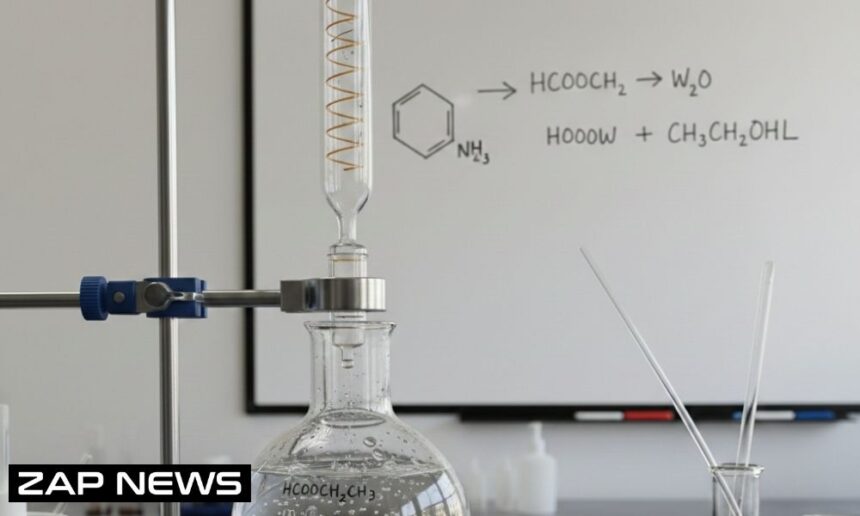
The chemical expression HCOOCH CH2 H2O may initially appear complex, but it represents an important chemical system that illustrates fundamental reactions in organic chemistry and industrial production. The formula combines three main components: HCOOCH (methyl formate), CH2 (methylene group), and H2O (water). Together, these elements are associated with reactions such as ester hydrolysis, which produce essential chemicals like formic acid and methanol.
These substances are widely used in manufacturing, fuel research, agriculture, and green chemistry initiatives. Understanding how these components interact helps explain many industrial processes and laboratory experiments. In this guide, we will explore the structure, properties, reaction mechanisms, industrial applications, environmental impact, and future innovations related to the HCOOCH CH2 H2O chemical system.
| Topic | Details |
|---|---|
| Keyword | HCOOCH CH2 H2O |
| Chemical Components | Methyl Formate (HCOOCH₃), Methylene Group (CH₂), Water (H₂O) |
| Reaction Type | Ester Hydrolysis |
| Main Products | Formic Acid (HCOOH) and Methanol (CH₃OH) |
| Industrial Uses | Fuel production, textile processing, chemical manufacturing |
| Scientific Field | Organic Chemistry |
| Key Property | Breaks ester bonds using water in hydrolysis reactions |
| Environmental Aspect | Supports green chemistry and sustainable fuel research |
| Common Applications | Laboratories, polymer production, pharmaceuticals |
| Safety Note | Methyl formate is flammable, methanol is toxic, and formic acid is corrosive |
Understanding the Components of HCOOCH CH2 H2O
To understand the meaning of HCOOCH CH2 H2O, we must analyze each chemical component individually.
Methyl Formate (HCOOCH₃)
The first part, HCOOCH, represents methyl formate, an ester produced from formic acid and methanol. Its molecular formula is HCOOCH₃. Methyl formate is a colorless liquid with a mild, sweet odor and is commonly used as a solvent and intermediate compound in organic synthesis.
Because of its ester structure, methyl formate easily reacts with water in hydrolysis reactions. This property makes it highly valuable in chemical manufacturing and laboratory studies.
Methylene Group (CH₂)
The CH2 group, also called the methylene unit, is an important structural component in organic molecules. It consists of one carbon atom bonded to two hydrogen atoms.
Although CH₂ does not normally exist as an independent molecule, it functions as a linking group in hydrocarbons and polymers. Many synthetic materials, plastics, and fibers contain repeating CH₂ units in their molecular chains.
Water (H₂O)
The final component, H2O, is one of the most essential molecules in chemistry. Water acts as both a solvent and reactant in numerous chemical reactions.
In the HCOOCH CH2 H2O system, water is responsible for breaking the ester bond in methyl formate through a reaction called hydrolysis. Its polar structure and hydrogen bonding ability make it extremely effective in promoting chemical transformations.
Hydrolysis Reaction of Methyl Formate
The most important reaction associated with this system is the hydrolysis of methyl formate.
The reaction can be represented as:
HCOOCH₃ + H₂O → HCOOH + CH₃OH
In this reaction:
-
Methyl formate reacts with water
-
The ester bond breaks
-
The products formed are formic acid (HCOOH) and methanol (CH₃OH)
This reaction is a classic example of ester hydrolysis, which converts esters into acids and alcohols. It is widely used in chemical industries to produce useful compounds from simpler materials.
Reaction Mechanism Explained
The hydrolysis process occurs through a series of chemical steps.
Step 1: Protonation
In acidic conditions, the oxygen atom of the ester becomes protonated by an acid catalyst. This increases the reactivity of the carbonyl carbon atom.
Step 2: Nucleophilic Attack
A water molecule attacks the activated carbonyl carbon, forming a tetrahedral intermediate.
Step 3: Bond Rearrangement
After proton transfer within the molecule, the ester bond begins to break.
Step 4: Product Formation
Finally, the molecule splits to produce methanol and formic acid.
In basic conditions, a similar reaction occurs but is known as saponification, producing formate salts and methanol instead.
Physical and Chemical Properties
Understanding the physical properties of these compounds helps explain their industrial importance.
Methyl Formate
-
Colorless liquid
-
Boiling point: about 32°C
-
Density: approximately 0.97 g/cm³
-
Flammable and volatile
-
Slightly soluble in water
Formic Acid
-
Pungent odor
-
Boiling point: 100.8°C
-
Completely soluble in water
-
Strong hydrogen bonding ability
Methanol
-
Clear liquid alcohol
-
Boiling point: 64.7°C
-
Highly flammable
-
Fully miscible with water
CH₂ Units
The methylene group plays an important role in molecular structures, influencing the reactivity and formation of larger organic compounds.
Industrial Importance of HCOOCH CH2 H2O
The chemistry behind HCOOCH CH2 H2O has major industrial applications.
Formic Acid Production
One of the most valuable products of this reaction is formic acid. It is widely used in:
-
Leather processing
-
Textile dyeing
-
Agriculture as a feed preservative
-
Antibacterial treatments
-
Chemical reduction reactions
Formic acid is also being explored as a clean energy carrier in fuel cell technologies.
Methanol Production
Another product, methanol, is an extremely important industrial chemical. It is used to manufacture:
-
Biodiesel
-
Formaldehyde
-
Plastics
-
Adhesives
-
Industrial solvents
Methanol is also being researched as a hydrogen carrier for alternative fuels.
Polymer and Plastic Manufacturing
The CH₂ group forms the backbone of many polymers and synthetic materials used in everyday products such as plastics, fibers, and coatings.
Role of Water in the Reaction
Water is more than just a solvent in the HCOOCH CH2 H2O system.
It acts as an active reactant, participating directly in the hydrolysis process. Water molecules break ester bonds and stabilize reaction intermediates through hydrogen bonding.
Additionally, water helps control pH levels, which is critical for regulating reaction speed and efficiency in industrial chemical production.
Laboratory Applications
In laboratory settings, the hydrolysis of methyl formate is often used to demonstrate ester reactions.
Typical experiments involve:
-
Heating methyl formate with water under reflux
-
Adding acid or base catalysts
-
Monitoring reaction progress using titration or spectroscopy
Techniques like infrared spectroscopy (IR) and nuclear magnetic resonance (NMR) help chemists study the reaction mechanism and confirm the formation of products.
Safety Considerations
Working with these chemicals requires careful safety procedures.
-
Methyl formate is highly flammable and should be handled in ventilated environments.
-
Formic acid is corrosive and can cause skin burns.
-
Methanol is toxic and dangerous if ingested or inhaled.
Laboratory workers must use protective gloves, goggles, and proper storage containers when handling these substances.
Environmental and Sustainability Aspects
The HCOOCH CH2 H2O reaction system fits well within the principles of green chemistry.
Many reactions occur in water-based environments, reducing the need for harmful organic solvents. Additionally, formic acid and methanol can be produced from renewable resources, reducing reliance on fossil fuels.
Scientists are also studying carbon dioxide conversion methods to produce formic acid, creating more sustainable chemical production cycles.
Real-World Applications
The chemistry of this system supports many modern technologies.
For example:
-
Direct formic acid fuel cells provide compact energy sources for portable devices.
-
Textile industries use formic acid in dye processing.
-
Pharmaceutical companies use methanol as a solvent and chemical intermediate.
-
Polymer industries rely on CH₂ chains for creating durable materials.
These examples demonstrate how a simple reaction system contributes to global industries.
Common Misunderstandings
Several misconceptions exist regarding HCOOCH CH2 H2O.
Some people assume it represents a single molecule, but in reality it describes a reaction system involving multiple compounds.
Another misconception is that CH₂ exists independently, when in fact it normally appears only as part of larger molecules.
Understanding these details helps clarify the chemical behavior of this system.
Future Developments
Research on this chemical system continues to grow.
Scientists are exploring new uses such as:
-
Carbon-neutral fuel systems
-
AI-designed catalysts
-
Advanced polymer materials
-
Sustainable chemical manufacturing
With ongoing innovation, the chemistry behind HCOOCH CH2 H2O may play an even larger role in future technologies.
Conclusion
The HCOOCH CH2 H2O chemical system highlights essential principles of organic chemistry, industrial production, and environmental sustainability. Through the hydrolysis of methyl formate, valuable compounds such as formic acid and methanol are produced, both of which have widespread industrial uses.
Understanding this reaction not only improves chemical knowledge but also supports the development of greener technologies and efficient manufacturing methods. For researchers, students, and industry professionals, studying this system offers valuable insight into the future of chemical science.
FAQs
What does HCOOCH CH2 H2O represent?
It represents a chemical system involving methyl formate, methylene groups, and water, commonly studied in ester hydrolysis reactions.
What is the main reaction involved?
The key reaction is hydrolysis, where methyl formate reacts with water to produce formic acid and methanol.
Why is this reaction important?
It helps produce useful chemicals used in fuels, manufacturing, agriculture, and pharmaceuticals.
Is this reaction safe?
The reaction must be handled carefully because methyl formate is flammable, methanol is toxic, and formic acid is corrosive.
Where is this chemistry used?
It is used in industrial production, fuel research, polymer manufacturing, and chemical laboratories.
For More Inforamation Visit zapnews.co.uk