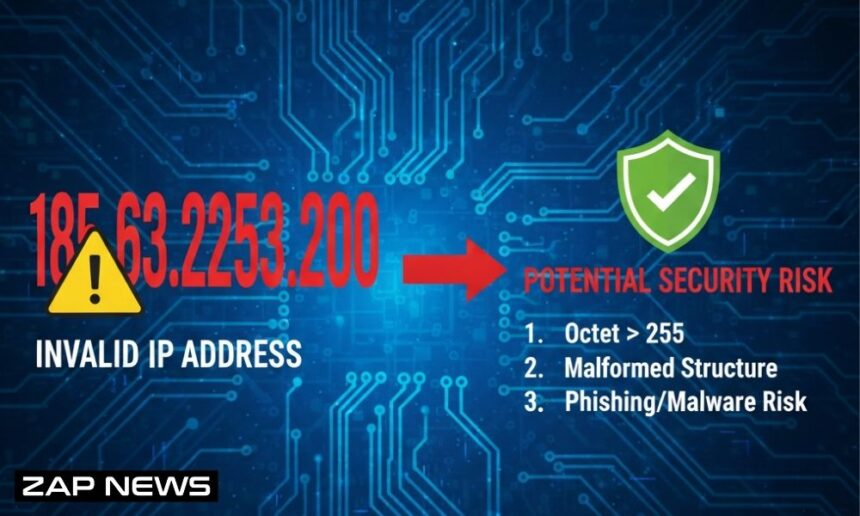
Introduction: Understanding the Mystery Behind 185.63.2253.200
At first glance, 185.63.2253.200 looks like a standard internet address—just another IPv4 number you might spot in a server log, firewall alert, or security report. However, a closer inspection reveals that this sequence is not a valid IP address at all. Despite this, it still appears in real-world scenarios, raising questions about where it comes from, why it shows up, and whether it poses a security risk.
In modern networking and cybersecurity, even small anomalies can signal larger problems. Invalid or malformed IP addresses like 185.63.2253.200 can result from simple human error—but they can also point to misconfigurations, faulty software, or even malicious activity. Knowing how to recognize and interpret these anomalies is essential for developers, system administrators, and everyday users alike.
This guide breaks down everything you need to know about 185.63.2253.200—what makes it invalid, how it might appear, the potential risks involved, and what steps to take if you encounter it.
What Is an IP Address?
An IP (Internet Protocol) address is a unique numerical identifier assigned to devices on a network. It allows computers, servers, smartphones, and other devices to communicate with one another across the internet or within local networks.
Common IP Versions
-
IPv4 – Uses four numbers separated by dots (e.g., 8.8.8.8)
-
IPv6 – Uses a longer alphanumeric format designed to support more devices
IPv4 remains the most widely used format today, and it follows strict numerical rules. Any deviation from these rules immediately renders an address invalid.
IPv4 Structure Explained (And Where 185.63.2253.200 Fails)
An IPv4 address consists of four octets, each ranging from 0 to 255.
Valid Example:
Problematic Example:
| Octet | Value | Allowed Range | Status |
|---|---|---|---|
| 1st | 185 | 0–255 | Valid |
| 2nd | 63 | 0–255 | Valid |
| 3rd | 2253 | 0–255 | ❌ Invalid |
| 4th | 200 | 0–255 | Valid |
The third octet exceeds the maximum allowable value, making the entire address invalid and non-routable.
Why Does an Invalid IP Like 185.63.2253.200 Appear?
Even though it cannot exist as a real network address, 185.63.2253.200 may still show up in various technical contexts.
Common Reasons Include:
1. Typographical Errors
A simple mistake—such as typing 2253 instead of 253—can generate an invalid address.
2. Log Parsing or Software Bugs
Some logging systems incorrectly concatenate values or misread input data, producing malformed IPs.
3. Misconfigured Network Devices
Routers, firewalls, or proxies with outdated firmware may improperly record IP information.
4. Automated Scans or Bots
Bots probing systems sometimes inject malformed data intentionally to test defenses.
Can 185.63.2253.200 Be a Security Threat?
While the IP itself is invalid, its presence can still signal risk.
Potential Security Implications
-
IP Spoofing Attempts
Attackers may use malformed addresses to disguise traffic sources or confuse logs. -
Firewall Evasion Tests
Some attacks test whether systems properly validate input before processing packets. -
Log Pollution
Invalid IPs can clutter logs, making real threats harder to detect. -
DDoS or Brute-Force Campaigns
Malformed IPs may appear alongside repeated access attempts or scanning activity.
Understanding IP Spoofing and Malformed Addresses
IP spoofing involves falsifying the source address of network traffic. While spoofed IPs don’t always need to be valid, they can still disrupt systems that fail to validate packet headers properly.
In poorly secured environments:
-
Malformed IPs may bypass filters
-
Logs may record misleading data
-
Incident response may be delayed
Seeing an address like 185.63.2253.200 should prompt a review—not panic, but investigation.
How to Check Whether an IP Address Is Legitimate
Manual Validation
Ask three quick questions:
-
Does it have exactly four octets?
-
Are all octets numeric?
-
Are all values between 0 and 255?
If the answer to any is “no,” the IP is invalid.
Helpful Tools for IP Analysis
-
WHOIS Lookup – Checks ownership and allocation
-
AbuseIPDB – Reports malicious activity
-
IPinfo – Provides ISP and region data
-
VirusTotal – Flags known threats
Invalid IPs like 185.63.2253.200 will usually be rejected immediately.
What To Do If You See 185.63.2253.200 in Logs
-
Confirm Invalidity
Verify that the IP does not meet IPv4 standards. -
Check Context
Look at timestamps, actions attempted, and related entries. -
Search for Patterns
Are there multiple malformed IPs? Repeated attempts? -
Review Firewall & IDS Rules
Ensure malformed packets are dropped automatically. -
Block or Monitor IP Ranges (If Needed)
If similar valid IPs from the same range show abuse, consider rate-limiting. -
Update Software and Firmware
Fix potential logging or parsing bugs.
Best Practices for Preventing IP-Related Issues
-
Enable strict IP validation
-
Keep firewalls and IDS systems updated
-
Monitor logs for anomalies
-
Use SIEM tools for centralized analysis
-
Avoid interacting with suspicious IP-based links
-
Use VPNs and updated antivirus software
Proactive monitoring is far more effective than reactive cleanup.
Final Verdict: Is 185.63.2253.200 Legit or Dangerous?
185.63.2253.200 is not a valid IP address.
Its structure violates IPv4 rules, making it unusable for legitimate networking.
However, its appearance should never be ignored. Whether caused by a typo, software error, or malicious probing, malformed IPs can reveal weaknesses in systems and security practices.
Understanding why such addresses appear—and how to respond—helps ensure your network remains accurate, resilient, and secure.
FAQs About 185.63.2253.200
Is 185.63.2253.200 a real IP address?
No. The third octet exceeds the IPv4 limit of 255.
Can invalid IPs be used in cyberattacks?
Yes. They may be used for spoofing, testing defenses, or obfuscation.
Should I block it?
You can’t block an invalid IP directly, but you should ensure malformed traffic is rejected.
Why does it appear in my logs?
Most often due to typos, parsing errors, misconfigurations, or spoofed traffic.
For More Inforamation Visit zapnews.co.uk